Gerlach en de heren van Valkenburg

The rise of the lords of Valkenburg
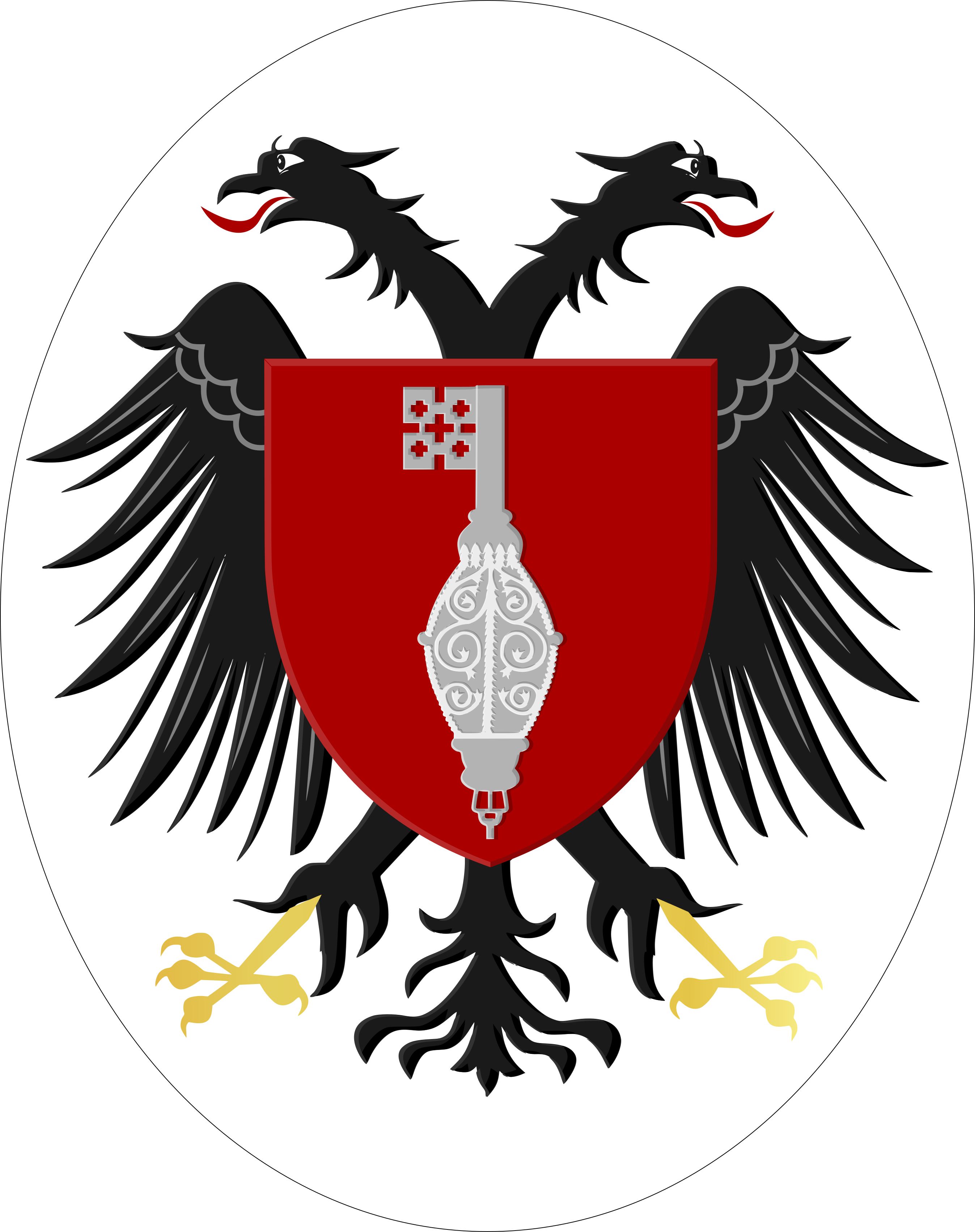
The monastery in Heinsberg to which the shrine of St. Gerlach was donated in 1165 was the house monastery of the lords of Valkenburg-Heinsberg. Such a monastery was often also an administrative and religious centre for the lord of the manor. St. Gerlach and Valkenburg developed into its own administrative centre of the county at the time of the foundation of the monastery (1202) over the grave of St. Gerlach. Instead of the small wooden church in which St. Gerlach was buried, a monastery with a stone church came into being. In Valkenburg a castle had already been built on the Heins hil (=Heinsberg) by the lords of Valkenburg from 1075, from which the Land of Valkenburg was governed.
Valkenburg is first mentioned as "Falckenberch" in a charter of the German king Hendrik III. On 15 February 1041, at the request of Gozelo, Duke of Lorraine and his son Godfried, the latter donated to his niece Irmgard possessions in Herve, Vaals, Epen and Valkenburg, originating from the property of his father Emperor Coenraad II, to do with them as he saw fit.
Property in Houthem
A charter of Bishop Otbert of Liege from the year 1096 mentions the purchase of a domain in Houthem by Gozewijn I of Valkenburg. Ties with Valkenburg-Heinsberg are also mentioned in the Vita of St. Gerlach. It says that Gerlach was visited by a noble lady, Oda of Heinsberg, possibly the wife of Gozewijn I, Oda of Walbeck. She remembered Gerlach from when he was a young knight and rejoiced at his change. She favoured the hermitage by donating to Gerlach land around the hermitage.
The heyday of the Lords of Valkenburg / Italian campaigns
At that time the lords of Valkenburg played an important role in the politics of the Holy Roman Empire. Those politics were partly determined by the investiture struggle between the kings and emperors of the Holy Roman Empire on the one hand and the Pope in Rome on the other, and by the crusades to the Holy Land. Many local knights accompanied the lords of Valkenburg on the campaigns they conducted together with the emperor and the bishops of Cologne and Mainz against the pope in Italy and the German emperor on his crusades to the Holy Land. During the time Gerlach was pilgrimaging to Rome and Jerusalem, the imperial armies were departing in the same direction. Gozewijn II attended the coronation of Frederick Barbarossa in Aachen on 9 April 1152. His son Gozewijn III accompanied this famous German emperor on his campaigns to Italy, where he gained fame as a general and governor of conquered territory. His brother Philip of Valkenburg, supported by Frederick Barbarossa, became provost of the St. Lambert Chapter in Liege and even archbishop of Cologne and chancellor of Italy. With this, the lords of Valkenburg were at the peak their power at the same time that their former knight Gerlach in Houthem chose the simple life of a hermit in the Geul valley.
Crusades and the foundation of the monastery in Houthem
Emperor Frederick Barbarossa not only waged war in Italy but also participated in the Third Crusade. This became fatal to him. He drowned in 1190 while crossing a river in what is now Turkey. That was not the end of the Crusades. In 1198 there was a new crusade. Gozewijn IV of Valkenburg was one of the knights who then promised to take up the cross and go on a crusade. However, when push came to shove, Gozewijn IV did not go on a crusade. Because he had broken his crusading promise, he was put under an ecclesiastical ban. By donating land in Houthem for the foundation of the monastery in St. Gerlach, Gozewijn IV was able to undo his ban. From the charter (no. 1) that was drawn up at the time, we know for certain that the breaking of this promise led to the foundation of the Norbertines convent in St. Gerlach.
Want to know more?
In Valkenburg you can visit the ruins of the castle of the Lords of Valkenburg. In Cologne Cathedral there is the mausoleum of Philip of Valkenburg and the relics of the Three Kings, for which Philip had a beautiful reliquary made.


partners



donors